


Most enterprise AI research still runs a string of separate jobs. Find some papers. Pass the list along. Track down the full text. Load it into a model. Wait for an output. Every step starts and stops, and a person stitches the pieces together in between.
That's not how the strongest agentic systems work. When the underlying infrastructure is connected so that discovery, access, and analysis are all reachable from a single pipeline, an agent stops waiting for hand-offs. It runs the whole loop, and each pass feeds the next. Research becomes a flywheel instead of a checklist.
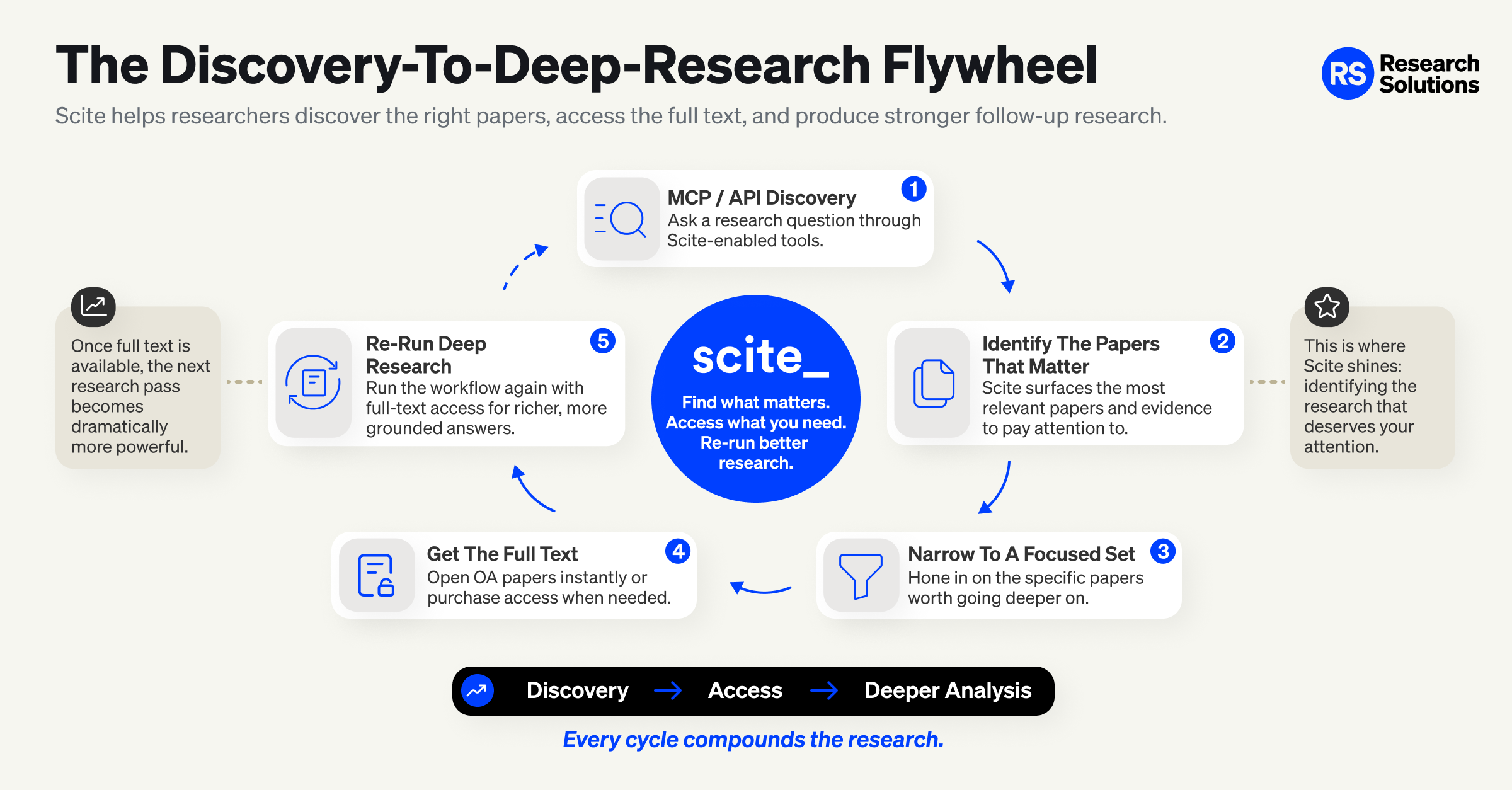
The reason this matters for research teams is straightforward. An agent that has to stop and request a paywalled paper, or hand its findings to a human to go acquire access, can only do so much before it stalls. An agent sitting atop connected discovery and access infrastructure keeps going. It surfaces the right literature, retrieves what it needs, analyzes it, and uses what it learns to ask sharper questions on the next turn.
What Turns The Loop
Two capabilities must work together for that loop to run on its own.
The discovery layer has to surface the right snippets or citations, not just the most-cited ones or whatever happens to be open access. Scite handles this. Its Smart Citations rank papers by how the scientific community has engaged with the work: whether findings have been supported, contradicted, or mentioned in passing by later research. That signal matters when you're running a synthesis pipeline, because you want the papers your agent treats as authoritative to reflect real evidentiary weight, not citation volume alone. Scite also provides broader full-text coverage, with the ability to surface exactly where data and insights come from in an article, than any other tool in its category. That means the discovery layer works from more complete source material from the start.
The access layer should ideally deliver full text reliably, including purchasing content behind paywalls. The Article Galaxy API handles this. When Scite surfaces a paper worth going deeper on, the API retrieves the full text on demand. It checks your existing rights and entitlements first, serves open access where available, and purchases what isn't already covered. Acquired articles are delivered to your organization's Article Galaxy account, ready for the next step in the workflow.
Most vendors power one node of this loop. Powering both is what keeps the flywheel turning instead of stalling at every handoff.
One Turn Of The Flywheel
Start with a research question, fed through a Scite-enabled tool via the API or MCP. Scite returns the most relevant papers and citation evidence, ranked by Smart Citations data. From that set, the agent or pipeline narrows to the specific papers worth deeper analysis. The Article Galaxy API acquires full text for those titles, along with the per-article AI rights that authorize analysis, available from participating publishers, with CC-BY content already cleared by its license. Rights-cleared articles then feed the AI tools your team runs: deep research agents, document Q&A pipelines, synthesis workflows, etc. The analysis works from the papers themselves, not abstracts and metadata summaries.
Then it runs again. With full text for those papers now in your pipeline, the next pass is more grounded. The agent asks better follow-up questions because it's reasoning over more complete material. Each turn compounds on the last.
Every piece of this runs on licensed content. Where AI analysis is part of the workflow, Article Galaxy secures per-article AI rights from participating publishers, so everything your pipeline ingests is cleared for exactly that use. For teams answering to compliance and legal review, that provenance is part of the value.
A Library That Gets More Useful Over Time
The flywheel has a longer-term payoff that's easy to underestimate during an evaluation.
Every article acquired through the Article Galaxy API gets added to your organization's literature library with any associated Re-Use and AI Rights noted. That library is persistent and searchable, which means every paper your team has already acquired stays available for the next research question. As the collection grows across projects, therapeutic areas, and research questions, your team builds a deeper body of full-text literature that it has already paid for, and the articles cleared for AI use are ones your agents can return to without reacquiring anything.
That's a different proposition than per-article access. Each acquisition adds to a resource that the whole team can search later, so every future turn of the flywheel starts from a stronger position.
Why This Combination Is Hard To Replicate
Most tools in this space power one part of the loop. A citation intelligence platform can help evaluate and prioritize literature, but it can't fulfill paywalled access programmatically. A content aggregator can retrieve articles, but it has no citation-level intelligence to tell your agent which papers are worth retrieving in the first place.
The Scite and Article Galaxy API combination covers it all:
-
Discovery ranked on evidentiary quality
- Access that follows from that ranking automatically
- A systematic approach to the iterative research cycle
For teams running AI research in-house, search coverage is the easy part. The harder questions are what the system can ingest, and how much your team trusts what goes in. A connected flywheel answers both.
Get API access to Scite and Article Galaxy and put the whole loop to work.