


Four On Demand Sessions
AI For Research
ChatGPT · Claude · Cowork · Codex

AI Tools, Made Ready For Real Research
This series is for researchers trying to figure out where AI fits in their work. We're taking four of the most widely used AI tools, showing you how each one works, and walking through how to make each one trustworthy enough to use in a real research context.
What Every Session Covers
Tool Overview
What the AI tool does and where it fits in a research workflow
MCP Research Layer
Adding Scite & Article Galaxy MCPs to make AI outputs trustworthy
Live Setup
Watch us connect the MCPs in real time - two minutes, start to finish
Research Prompts
Live prompting, with outputs you can replicate the same day
Program Overview
Four 60-Minute Sessions | Session Replays
-
ChatGPT For Research
ChatGPT is one of the most widely used AI tools in the world. On its own, it's a genuinely powerful tool. But it wasn't built for the kind of source verification researchers rely on every day.
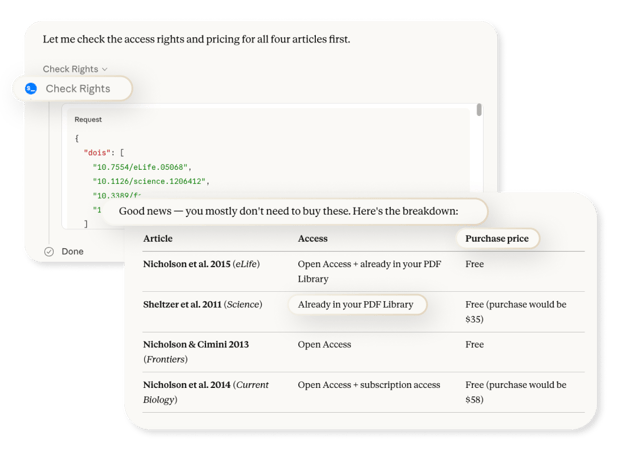
We'll show how to make it research-ready by connecting Scite and Article Galaxy MCPs, then run prompts for reference checking, gap analysis, getting the full text with AI Rights, and more. See what changes when you ground it in verified literature: fewer hallucinated references, citation context built into every response. -
Claude Chat For Research
Claude's chat interface provides more context in a single conversation than almost any other tool available, making it well-suited for literature synthesis and long-form research writing. It can do a lot on its own.
The gap is that it wasn't built to verify sources or flag when a reference doesn't hold up. We'll show how to make it research-ready by connecting Scite and Article Galaxy, then run prompts for reference checking, gap analysis, getting the full text with AI Rights, and more. See what changes when you ground it in verified literature: fewer hallucinated references, citation context built into every response. -
Claude Cowork For Research
Cowork sits between Claude Chat and Claude Code, an agentic desktop tool that takes a task from description to finished deliverable without requiring anyone to write code. A capable tool for getting work done. Turning it into something a researcher can trust takes a bit more setup.
We'll show how to make it research-ready by connecting Scite and Article Galaxy, then run prompts for reference checking, gap analysis, getting the full text with AI Rights, and more. See what changes when you ground it in verified literature: fewer hallucinated references, citation context built into every response. -
Codex For Research
Codex is OpenAI's coding agent and, for research teams, it means going further than any chat interface can: reproducing validated methods into working code, building analysis pipelines, and generating interactive dashboards from real literature. It can move fast and go deep. But without verified sources behind it, the outputs are only as reliable as the model's training data.
We'll show how to make it research-ready by connecting Scite and Article Galaxy, then run prompts for reference checking, gap analysis, getting the full text with AI Rights, and more. See what changes when you ground it in verified literature: fewer hallucinated references, citation context built into every response.
We'll show how to make it research-ready by connecting Scite and Article Galaxy MCPs, then run prompts for reference checking, gap analysis, getting the full text with AI Rights, and more. See what changes when you ground it in verified literature: fewer hallucinated references, citation context built into every response.
The gap is that it wasn't built to verify sources or flag when a reference doesn't hold up. We'll show how to make it research-ready by connecting Scite and Article Galaxy, then run prompts for reference checking, gap analysis, getting the full text with AI Rights, and more. See what changes when you ground it in verified literature: fewer hallucinated references, citation context built into every response.
We'll show how to make it research-ready by connecting Scite and Article Galaxy, then run prompts for reference checking, gap analysis, getting the full text with AI Rights, and more. See what changes when you ground it in verified literature: fewer hallucinated references, citation context built into every response.
We'll show how to make it research-ready by connecting Scite and Article Galaxy, then run prompts for reference checking, gap analysis, getting the full text with AI Rights, and more. See what changes when you ground it in verified literature: fewer hallucinated references, citation context built into every response.